Sunday, November 22, 2015

Aha, "Judge not"


“Judge not . . .” is a well-known passage . . . even by not-yet-Christians. How many times have we heard not-yet-Christians, with an index finger wagging in the air and an “aha”, remind us? Though Matthew 7:1-5 is well-known, verse 6 is much less known:


“Do not give dogs what is holy, and do not throw your pearls before pigs, lest they trample them underfoot and turn to attack you.(Matthew 7:6 ESV)


The fact is, verses 1-6 form the complete idea. What happens when you take them together? Let’s put the two together in abbreviated form:


Wait now; if we’ve just determined that somebody is a dog or a pig, did we not just judge? And Jesus, of all people, compels us to withhold from these people. Does this seem contradictory?


[I can put silly stuff on my blog since only 5 people read it]

Let’s examine the “Judge not” idea first.  If we look at this parallel saying in Luke 6:36-38, we can see that this “judge not” saying happens in the context of granting mercy. Without going into a long explanation here (go to my “Measuring by Mercy” post for more on this), I’ll suggest that this means something like “ don’t judge them unworthy of the same mercy that you rely upon.”  So, on the one hand, we look at a person, no matter how harried the situation, and know that he needs mercy upon mercy . . . like me.


Now let’s take a look at the “dogs and pigs” idea. I think it’s as simple as this: “don’t grant scoundrels who defame The Gospel the courtesy of hearing truth that they then only defame. . . i.e., keep your mouth shut.”


I just wrote “as simple as . . . .” Is it ever simple to know what to say, how to say it, or if to say it? Not so much. This is the reason it’s not simple: Theses two saying represent two sides of an issue, two extremes, one juxtaposition.  I view it like this:
Someplace in between the two extremes is the right way to respond to people and circumstances. This situation calls for mercy upon mercy.  That situation calls for you to say nothing. Those situations call for a rebuke. Others call for a silent hug. Who knows? God knows. How do you know?  ASK, SEEK, KNOCK. The Holy Spirit will tell you where the Narrow Way is right now, with this person, under these influences, and in this circumstance. Don’t try to figure it out yourself. The way is too narrow, variable, and circumstantial for you to find it without asking. 
Loving does not look like the same thing in every case, not even with the same person the next time. It will turn out closer to one side of the juxtaposition or the other.

Monday, November 16, 2015

It always sounds like the Way of Love

When we hear the Holy Spirit, it always sounds like the “way of love.”  Note that these verses follow the “Ask, Seek, Knock” sequence that procures good things/Holy Spirit/wisdom:

“So whatever you wish that others would do to you, do also to them, for this is the Law and the Prophets. “Enter by the narrow gate. For the gate is wide and the way is easy that leads to destruction, and those who enter by it are many. For the gate is narrow and the way is hard that leads to life, and those who find it are few. (Matthew 7:12-14 ESV)

As you ask what to do or what to say regarding circumstances and situations at hand, the Holy Spirit will supply you with wisdom/discernment to deal with it.  It is very unlikely that you will know all of the circumstances and factors contributing to the situation for which you are seeking wisdom, so what you hear or are led to do may surprise you.  God's loving acts encompass a wide range of forms. Remember to trust that God most definitely wants to speak to you and that it will likely be through your thinking.

Tuesday, November 3, 2015

Getting the Conversation Going


Matthew 7:7-8
Ask, and it will be given to you; seek, and you will find; knock, and it will be opened to you. For everyone who asks receives, and the one who seeks finds, and to the one who knocks it will be opened.
Luke 11:9-10
And I tell you, ask, and it will be given to you; seek, and you will find; knock, and it will be opened to you. For everyone who asks receives, and the one who seeks finds, and to the one who knocks it will be opened.
James 1:5
If any of you lacks wisdom, let him ask God, who gives generously to all without reproach, and it will be given him.

Ask.  Never stop asking.  Ask through your intellect.  Ask with your mouth.  Ask via your heart.  Remember . . . God absolutely wants to speak wisdom into your being so you will know how He would have you respond to people and circumstances.  If you ask and know that He wants to and will give you this wisdom, trust that you receive wisdom in your innermost being to respond to the world around you.  Trust that your thoughts are not yours alone at the asking.

This asking is intended to go on nonstop.  Do not ever think that you will one day wear out your welcome in the conversation, saying “Now I have asked for one too many things one too many times.”  Jesus never did anything except what he heard the father saying (John 5:30) and saw the father doing (John 5:19).  Did he wear out his welcome in the conversation?

Saturday, October 31, 2015

Hear With the Mind of Christ

Have you ever held a conversation with yourself in your head?  Of course you have.  How does that conversation happen without making a sound with your mouth or receiving sound waves in your ears?  You can do it because God made you with a mind that can entertain such.

In chapter 2 of 1 Corinthians, Paul talks about the Holy Spirit language of Wisdom.   He emphasizes that people who have the Holy Spirit hear this kind of language.  Accepting Christ as Lord and Savior and thereby receiving the Holy Spirit is like turning on the higher conversational functionality of the mind.  Verse 16 is a lift from Isaiah 40:13, but he changes it up.  Where Isaiah uses the “Spirit of the Lord,” Paul changes it to “the mind of the Lord”--I think to direct our understanding to a critical aspect of hearing the Holy Spirit.

We have conversations with the Holy Spirit through our thinking mind.  Paul said that we who have the Holy Spirit have the mind of Christ.  We are then able to think things that are communicated to us by the Holy Spirit.  This should not be so surprising; God made our mind and wants to have a conversational relationship with us through it.  So, if God (through Paul) says that you have the mind of Christ, when you converse with Him, needing wisdom, shouldn’t you trust that he is putting commensurate thoughts in your mind?  So what if you don’t hear the booming voice out of the clouds?  You have the mind of Christ for every moment and every thought.

Tuesday, October 27, 2015

The Holy Spirit Language Is . . .

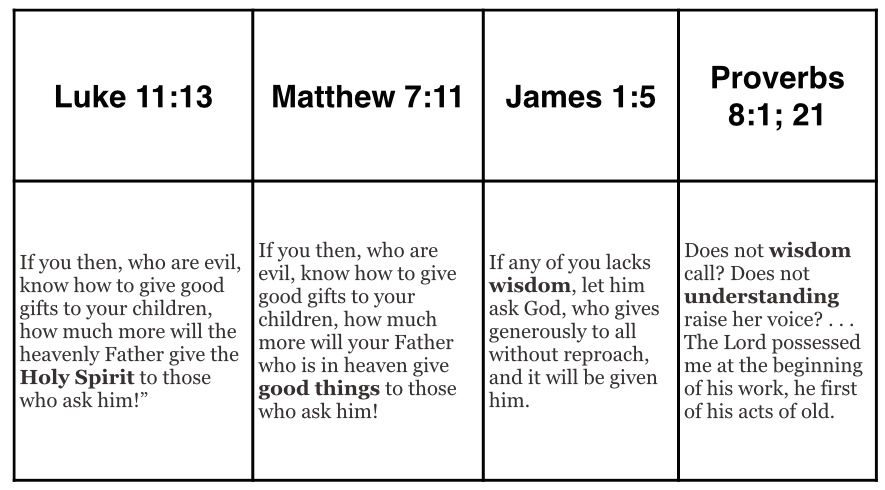
One of, and I contend the most usual, languages of the Holy Spirit with His humans is “good things,” “wisdom,” or “understanding.”  One aspect alone of understanding this is to look at how the passages in this graphic run parallel in thought:

I brought up Luke 11:13 a few days ago to emphasize God’s unwavering desire to give his Holy Spirit . . . to communicate with us.  You can see that Matthew recounted a sermon of Jesus wherein He just said “good things”.  James pretty much  plagiarized; he used the same idea as “wisdom.”  And I think we can look to the whole of Proverbs 8 to see that this is not new thing in the New Testament.  I have a lot to say about the Matthew and James passages.  A lot that I think will help with understanding how wisdom is a good thing and is a primary Holy Spirit language.  These passages of Scripture help us to understand how to function in the non-stop experience of communication with the Holy Spirit.  But blog-length writing can’t accommodate all of that in this post.  Next time.

Monday, October 26, 2015

Holy Spirit Language

When we talk to somebody and listen to somebody, we have to do so in a language we understand.  For me, that’s English.  I anticipate syllables formed by sounds; words formed by syllables; phrases formed by multiple words; and sentences formed phrases.  Some of us are pickier than others when it comes to grammar and syntax.

Whether or not you speak and comprehend in English, you generally expect people to form their sounds in Human.  What I mean by that is that, no matter what language, humans form their words in combination of labial, dental, and velar sounds.  Try this: Say “B” without bringing your lips together . . . that a labial sound; Say “T” without touching the back of your front teeth with the tip of your tongue . .  that’s a dental sound; Say “R” without using the back of your mouth near your throat . . . that’s velar or guttural.

Here’s my point: The Holy Spirit doesn’t have lips, teeth, a tongue, or a throat yet you may expect Him to speak English . . . or at least Human.  I’m not saying the the Holy Spirit is incapable of speaking English or Human, but you shouldn’t suppose that this would be the normal language system.  You may hear a booming voice from heaven or a whisper after the fire that sounds like English, but, Scripture and my experience (for whatever that’s worth) do not point to these as a norm.

Now you know that the Holy Spirit absolutely does want to speak to you and that you should be open to a different kind of language . . .  that is to say different than Human.  It’s a language that is more integrated with our being than our physiology.  If you’re imposing English or some other human language as the only legitimate language, you’re going to miss out on regular and non stop communication.

Saturday, October 24, 2015

“I Don’t Hear the Holy Spirit”

I’ve heard statements like this many times from committed Christians.  I recently sat in the back of an adult Sunday School class, most attendees had been Christians for decades, who one after the other, with angst, expressed concern that the Holy Spirit doesn’t speak to them or that they just don’t hear them.  The Holy Spirit speaks to you whether believer or not.  I intend to address this confusion, one aspect at a time, in short blogs.

The first aspect is this: You should take God at his Word.  

What father among you, if his son asks for a fish, will instead of a fish give him a serpent; or if he asks for an egg, will give him a scorpion? If you then, who are evil, know how to give good gifts to your children, how much more will the heavenly Father give the Holy Spirit to those who ask him!” (Luke 11:11-13 ESV)

Jesus assured us that the Father wants to give us the Holy Spirit.  He will not fail to do so.  With the above statements Jesus is basically saying that you are a real knothead if you persist in thinking that the Father might not want to give you the Holy Spirit.  He wants so much to give it that I think He will overcome quite a lot of hindrances to do so.  

Are you concerned that you are a believer, but do not hear the Holy Spirit? If so, first, get this into your heart and head . . . take him at his Word: The Father wants to and will give you the Holy Spirit.  This is the Spirit that is relational and communicative.